 ShipMind
The ship remembers.
Even when the crew changes.
An AI assistant on board your tankers. It answers from the ship’s own manuals, drawings and handover notes, works with the satellite switched off, and keeps every fix the crew finds for the next crew and the rest of the fleet.
Built by a former Chief Officer on chemical tankers, for the people who stand the watch.

- Works offline
- The model runs on a box on the ship, so it needs no satellite and there’s no bill per question.
- Shows its source
- Every answer names the document and page. If nothing matches, it says so.
- Your data stays yours
- It stays on your ships and your own servers, and never goes to us or to an AI provider.
Every rotation, the ship forgets
Knowledge on a ship lives in people, and people rotate every few months. The fix found at 02:00 goes into one handover, then the next one drops it. The same fault comes back, and the next crew solves it again from nothing.
- 3 to 4 times
- a year each senior post changes hands
- 1 in 4
- CDI/SIRE vetting findings repeat one the ship already had
- €15k to 25k
- lost for every day a chemical tanker is off hire
Sources: chemical tanker contract terms, 2026. Vetting data, Kaiko Systems, 2026. Womar pool and Odfjell results, 2025.
One box on board, with a screen for the crew, the ship and the office
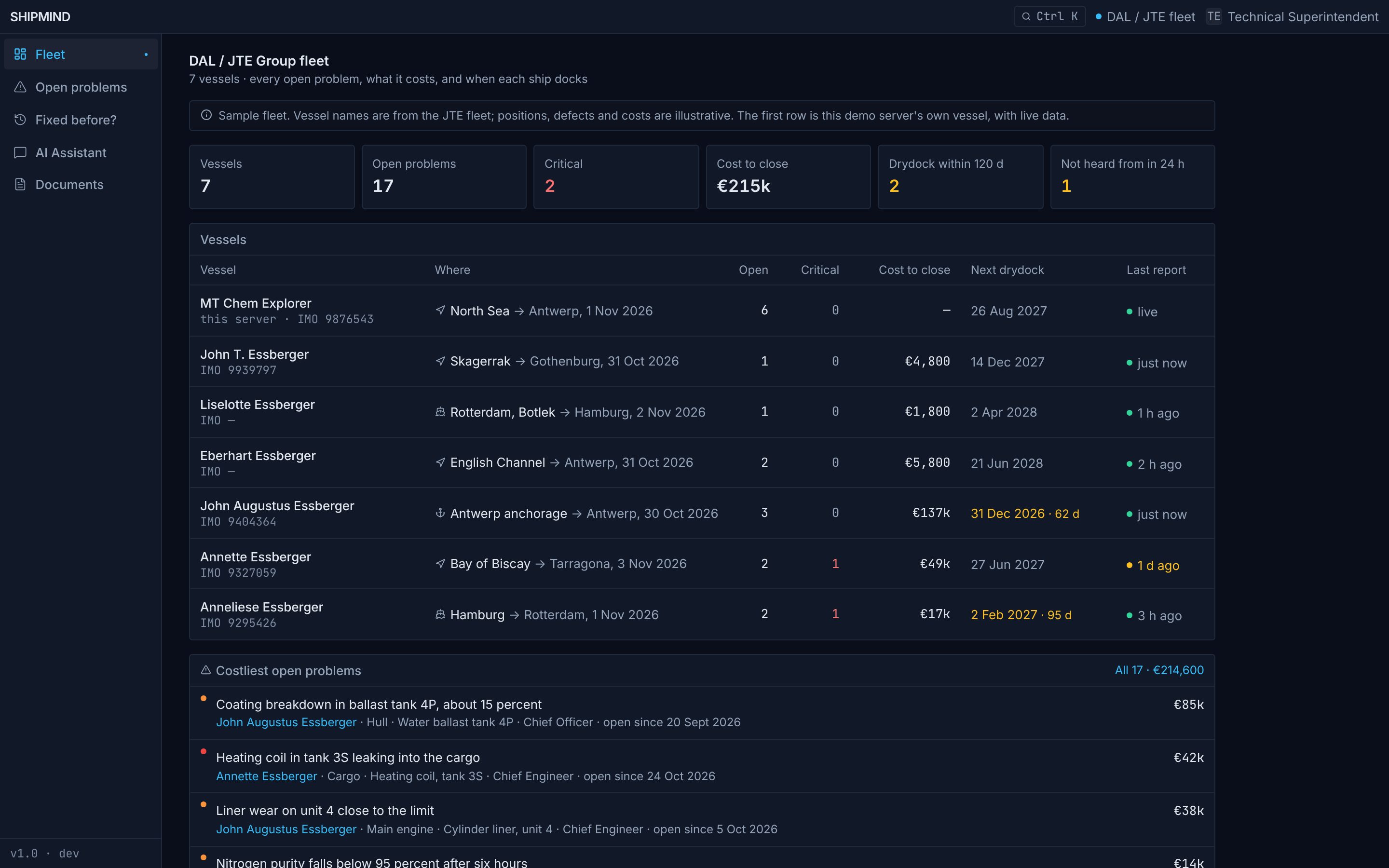
The crew ask from their phones, the officers work on the ship’s PC, and the office sees the whole fleet. All three run today.
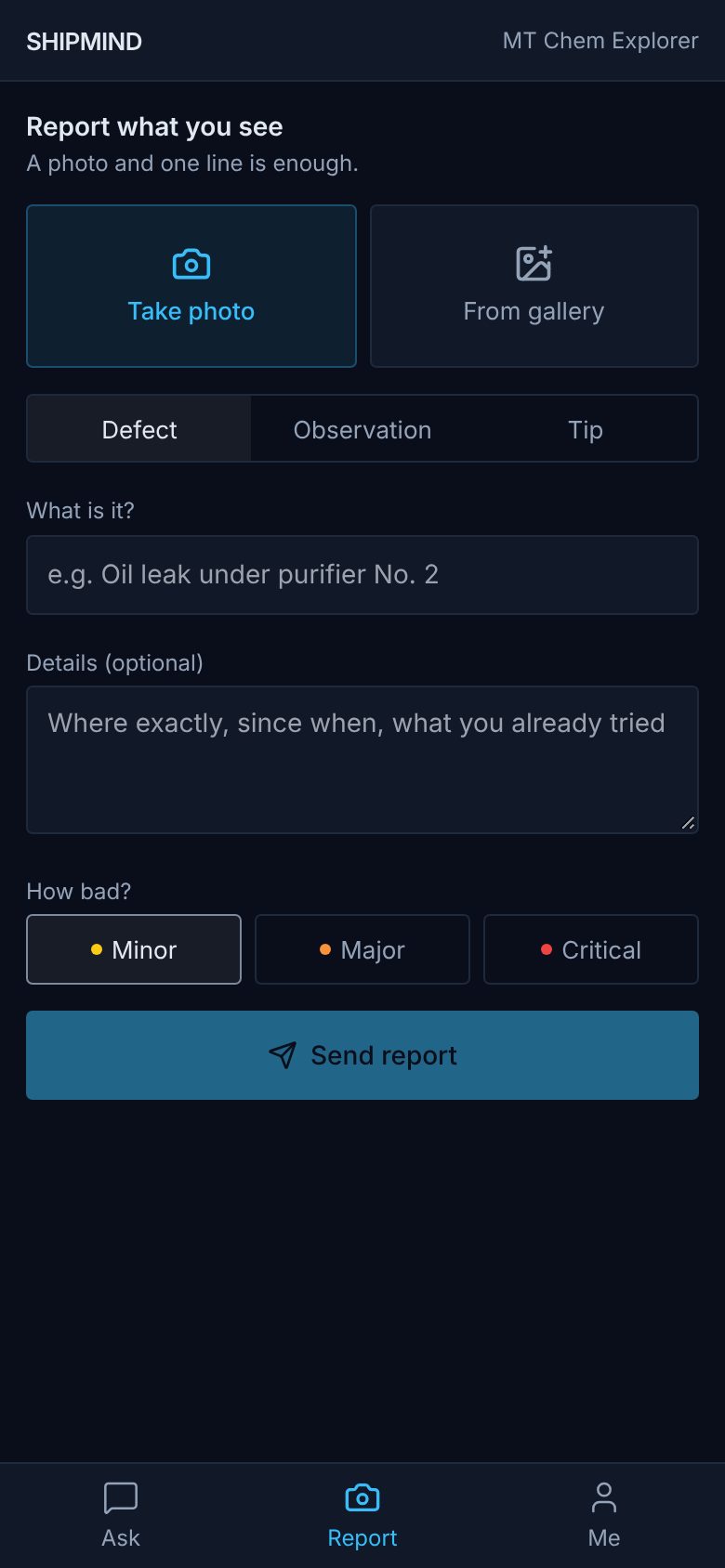
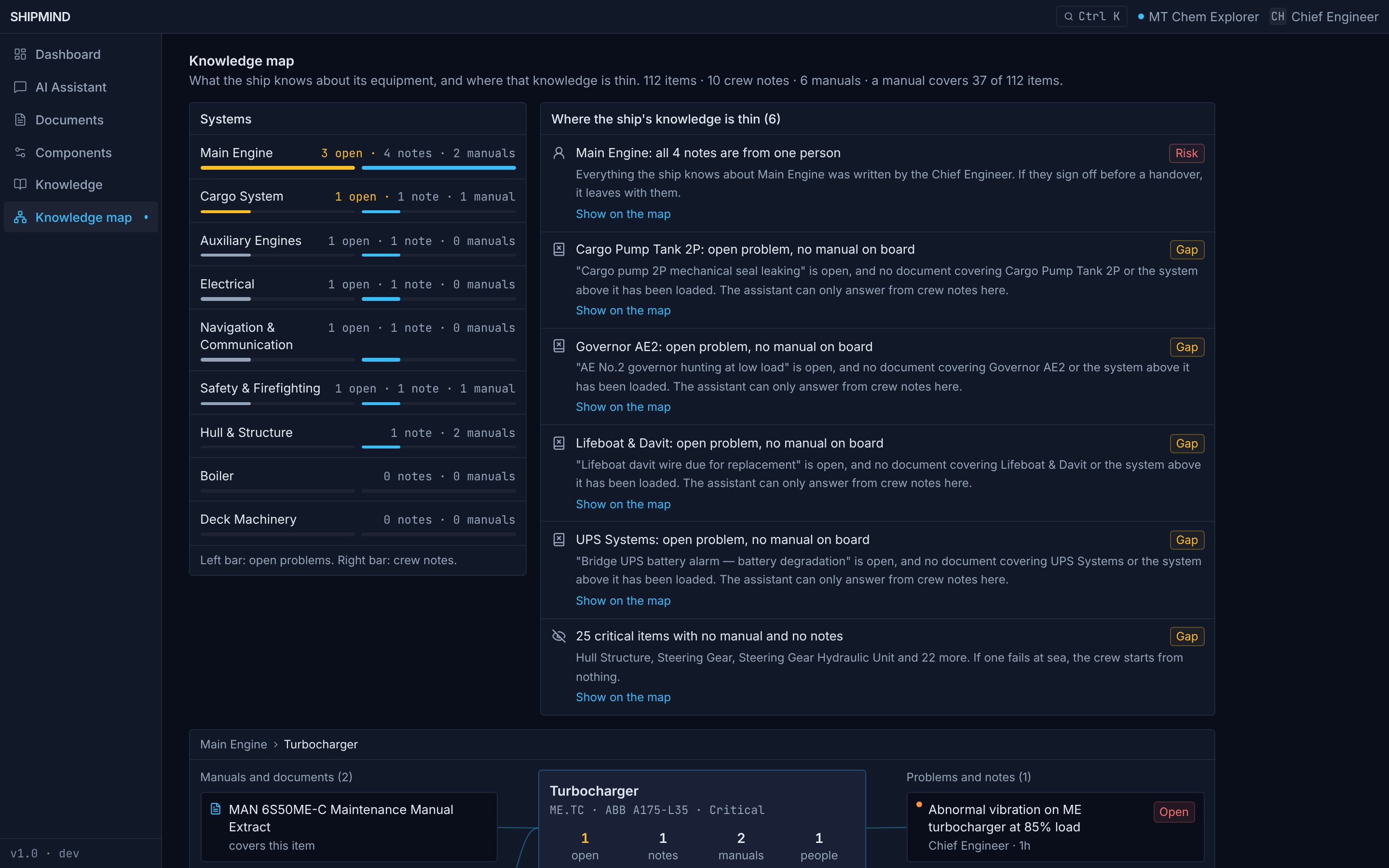
It reads what’s already on board, so there’s nothing new to fill in
Ask in plain English
“Why does the port ballast pump lose suction?” The answer comes from your manuals and earlier notes, with the page to check.
Keep every fix
When a problem is closed, the crew say what fixed it, in one line. The next crew finds it when the fault comes back.
Report from the deck
A photo and a sentence from a phone. The officers see it on the ship’s PC straight away.
See where knowledge is thin
Which machines have open problems and no manual, and which systems only one person on board knows.
Handovers that hold
Open items, their history and who worked on them stay on the ship when the crew signs off.
Answers in your crew’s words
Officers ask the way they talk, without learning search syntax or digging through “New folder (2)”.
It pays for itself if each officer saves half an hour a week
Everything after that is the return. We measure it with you from the first week, so nobody has to take our word for it.
- 30 min
- a week per officer covers the cost of ShipMind on that ship
- 1 day
- of off hire avoided every two and a half years also covers it
- 7×
- the cost comes back per ship a year at the pilot’s own targets
Pilot targets: 70% less time spent finding information, one off hire day a year avoided. Officer cost from 2025 chemical tanker wages, off hire day from the Womar pool, 2025.
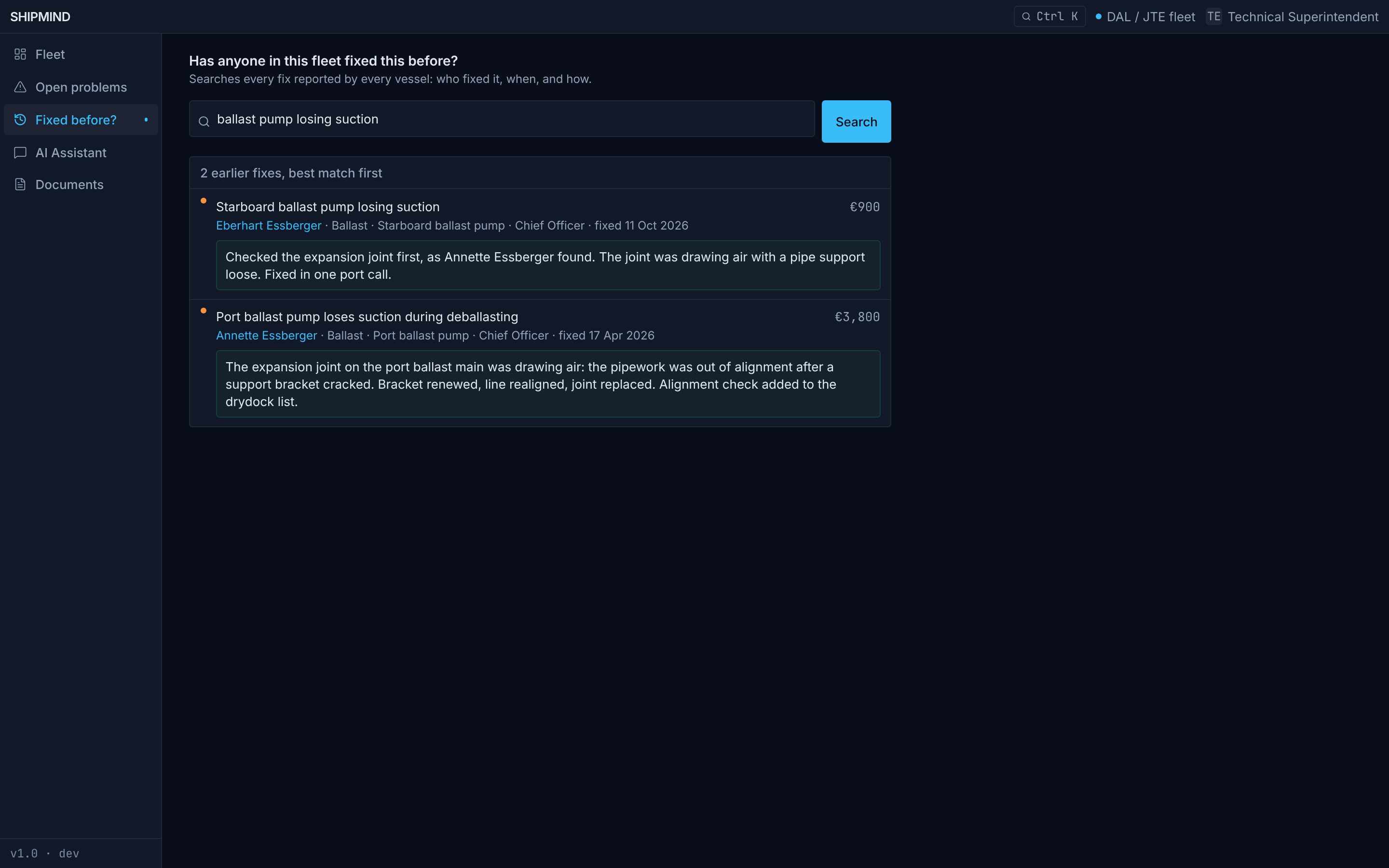
Has anyone in this fleet fixed this before?
With every ship connected, the office can ask across the whole fleet and get the answer with the ship, the date and what worked.
- Every open problem, costliest first
- Next drydock and last report for each ship
- Fixes that travel from one ship to the next
Built for a ship, not for an office
How it runs
- A box on the office network. It needs power and a network cable, and no yard visit, class approval or new cabling.
- No inbound connections. Updates to shore go out over the link you already have, when your IT says so.
- If we disappear, it keeps working. The software runs on your hardware, and fleet contracts include code escrow.
What it never does
- Write to statutory records. It never touches the oil record book or the log book.
- Decide for the officer. It finds the answer and shows where it came from, and the officer decides.
- Send your data anywhere you did not choose. No AI provider sees a word of it.
Start with five ships
A paid pilot, credited against the fleet contract if you go ahead. Success is five numbers we agree before we start, and you may add your own.
A 30 minute demo
On your own manuals, with your superintendent’s hardest questions.
Five ships, twelve months
First ship live in month one. Deck, cargo, pumps and safety first.
Then the fleet
Every ship connected, and the office sees what each one knows.
Why we built it
“My ship’s ballast pump kept losing suction. We found the cause and I wrote it into my handover. When I came back to the same ship, none of it was there any more.”
Stanislav Voloshchuk spent ten years at sea, five as Chief Officer on chemical tankers, then six years ashore in maritime software. ShipMind is the tool he wanted on board.
What technical directors ask first
Does it need an internet connection?
No. The language model, the search index and the database all run on the box on board.
Where does our data go?
It stays on the vessel. The fleet view runs on a server in your own office or data centre, never with us.
What if it gives a wrong answer?
Every answer lists the documents and pages it came from, so the officer can check it in seconds. By default it answers only from your documents, and says so when they do not cover the question.
Will the crew actually use it?
It asks nothing new of them. No forms and no extra reporting. They ask in plain English from a phone or the office PC. Weekly use is counted on the box and is the first number we report.
Does it replace our planned maintenance system?
No. It works beside AMOS, BASSnet or TM Master and needs no integration for a pilot. Your maintenance system records what was done, and ShipMind keeps what was learned.
Does it need class approval or a yard visit?
No. It is IT equipment on the ship's business network, like the ship's office PC. It needs power and a network cable.
How does it connect to shore?
Over the satellite link you already have. The box sends batched updates outbound only and accepts no inbound connections. Your IT decides the schedule. If they say no, every ship still works on its own.
What happens if ShipMind stops existing?
The boxes keep working, because the software runs on your hardware without us. Fleet contracts include source code escrow.
Is this just ChatGPT?
ChatGPT runs ashore, needs a connection, sends what you type to its provider, and does not know your ships. Here the model is the least interesting part. Your fleet's own memory is the product.
Bring your hardest question
Give us thirty minutes, your own documents and the question your superintendent asked last week. If the documents don’t cover it, ShipMind will say so.